
I still remember the first time one of my videos took off on Pinterest.
Not “viral” in the TikTok sense. No overnight fame. No dopamine-fueled comment storms. Just… steady. Quiet. A slow drip of saves, clicks, and traffic that kept showing up weeks later like a loyal customer who never announces themselves but always pays on time.
That’s when I realized something uncomfortable and powerful at the same time:
Pinterest videos aren’t built for chaos.
They’re built for responsibility.
And that’s exactly why using them ethically matters more here than on almost any other platform.
This article is not a Pinterest pep rally.
It’s not a recycled “best practices” list.
And it’s definitely not a sanctimonious lecture about morals in marketing.
It’s a real, opinionated, sometimes messy look at how content creators can use Pinterest video without lying, stealing, manipulating, or burning trust for short-term clicks.
Because Pinterest remembers.
And so do people.
First, Let’s Be Honest About What Pinterest Actually Is
Pinterest is not social media the way people pretend it is.
It doesn’t behave like TikTok.
It doesn’t reward chaos like Instagram.
It doesn’t thrive on outrage, hot takes, or dunking on strangers.
Pinterest is a visual search engine wearing a cozy cardigan.
People come here with intent:
- To plan
- To save
- To learn
- To buy (eventually, thoughtfully, without impulse regret)
That context changes the ethical rules.
On TikTok, manipulation disappears in 24 hours.
On Pinterest, a misleading video can quietly mislead thousands of people for years.
So if you treat Pinterest videos like disposable content scraps… you’re already on the wrong foot.
Ethical Use Starts With Intent, Not Tactics
Most ethical discussions online start in the wrong place.
They obsess over:
- Disclosures
- Watermarks
- Copyright rules
- Platform policies
Those matter, sure. But they’re downstream problems.
Ethical Pinterest video use starts earlier—with why you’re posting.
Ask yourself (and answer honestly, not performatively):
“If this video keeps getting views for two years, would I still stand by it?”
If the answer is “uhhh… maybe?”—pause.
Pinterest videos are slow-burn content.
They age like wine or like milk. No middle ground.
The Quiet Damage of Misleading Pinterest Videos
Here’s an unpopular opinion:
Misleading Pinterest videos are worse than misleading TikToks.
Because Pinterest users trust the platform more.
They’re planners. Researchers. DIYers. Small business owners. People making real decisions—money decisions, health decisions, life decisions.
When creators:
- Overpromise results
- Fake before/after transformations
- Tease solutions that don’t exist
- Bait clicks with incomplete information
…it’s not “growth hacking.”
It’s erosion.
And erosion doesn’t look dramatic. It just quietly destroys credibility until nothing stands.
Clickbait Is Lazy. Context Is Ethical.
Yes, Pinterest videos need hooks.
No, hooks don’t need to lie.
There’s a difference between:
- Curiosity and deception
- Teasing and tricking
- Optimizing and exploiting
Ethical creators understand that distinction instinctively.
Example:
❌ “This ONE trick made me $10K in 24 hours”
✅ “What actually helped me increase revenue—and what didn’t”
One respects intelligence.
The other insults it.
Pinterest users are not bored scrollers.
They are patient evaluators.
Treat them like adults.
Original Content Still Matters (Yes, Even Here)
Let’s talk about the elephant with a Canva account.
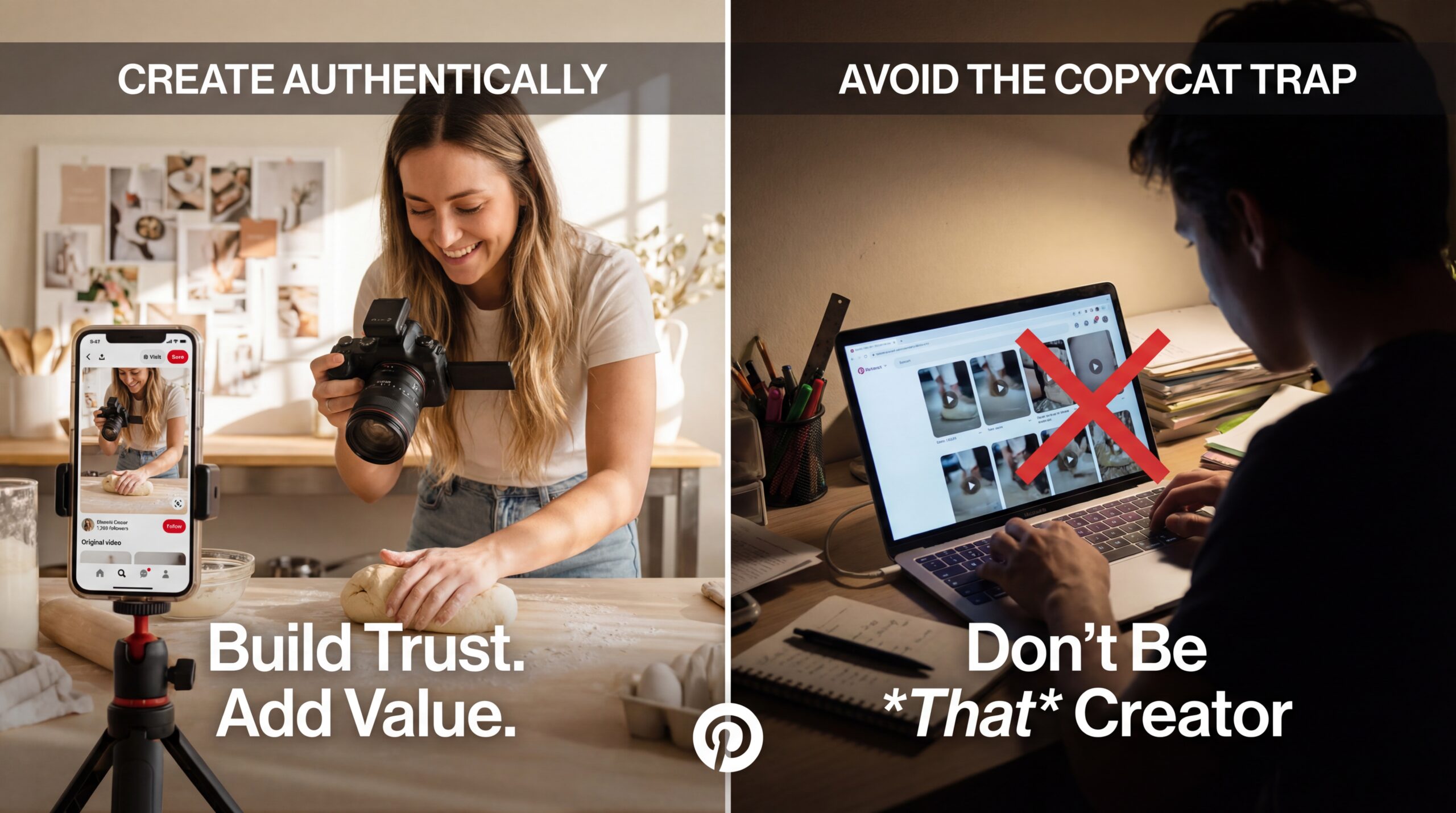
Reposting TikToks to Pinterest is not unethical by default.
But lazy repurposing absolutely is.
Ethical line you shouldn’t cross:
- Downloading viral videos you didn’t create
- Removing watermarks
- Reposting without transformation, context, or credit
- Flooding Pinterest with recycled noise
Pinterest rewards original framing, not originality theater.
If you’re repurposing:
- Re-edit the pacing
- Change the narrative angle
- Add platform-specific context
- Rewrite text overlays for Pinterest intent
If your video feels like it’s yelling instead of guiding, it probably belongs somewhere else.
Watermarks Aren’t the Issue. Respect Is.
A watermark doesn’t make a video unethical.
Disrespect does.
Creators who obsess over “removing TikTok watermarks for better reach” often miss the bigger problem: they’re optimizing distribution while ignoring meaning.
Pinterest doesn’t penalize authenticity.
It penalizes irrelevance.
Ethical creators don’t ask:
“How do I sneak this content everywhere?”
They ask:
“How does this content serve here?”
The Myth of “Pinterest Users Don’t Care”
I hear this all the time:
“Pinterest users don’t comment anyway, so it doesn’t matter.”
That’s not apathy.
That’s quiet trust.
Pinterest engagement is invisible but powerful:
- Saves
- Click-throughs
- Long-term discovery
- Repeat exposure
Abusing that silence is ethically gross.
Just because people aren’t yelling at you doesn’t mean they aren’t paying attention.
Affiliate Links, Sponsored Content, and the Honesty Gap
Let’s get real about money.
Yes, you can monetize Pinterest videos ethically.
No, you don’t need to pretend you’re doing it “just for fun.”
Ethical affiliate use on Pinterest looks like:
- Clear disclosures (not hidden in microscopic text)
- Honest pros and cons
- No fake scarcity
- No pretending you “just found this” yesterday
Pinterest users are researchers.
If you lie, they’ll find out—often silently.
And when they do, they won’t argue.
They’ll just stop clicking.
If You Wouldn’t Recommend It to a Friend, Don’t Pin It
This is my personal litmus test.
Before publishing a monetized video, I ask:
“Would I send this to someone I respect without a disclaimer speech?”
If the answer is no, the content isn’t ready.
Ethics isn’t about being perfect.
It’s about being aligned.
Teaching vs. Teasing: Where Most Creators Get It Wrong
Pinterest is not built for withholding information.
Creators who:
- Promise tutorials but deliver vibes
- Tease steps without substance
- Push users off-platform just to “find out more”
…are gaming the system—and users feel it.
Ethical Pinterest videos teach first, invite deeper later.
Give real value inside the pin:
- A complete idea
- A usable insight
- A clear takeaway
Then, if there’s more, link it.
Pinterest rewards generosity.
The Long Memory Problem (Why Ethics Is Also Strategy)
Here’s the cold, practical truth:
Ethical Pinterest video use isn’t just morally nice.
It’s algorithmically smart.
Pinterest:
- Resurfaces old content
- Tests pins over time
- Builds topical authority
If your video is honest, useful, and specific, it keeps working.
If it’s deceptive or shallow, it quietly dies.
No drama. No cancellation. Just… disappearance.
And nothing hurts more than content that almost worked.
Cultural Sensitivity Isn’t Optional Anymore
Pinterest has a massive global audience.
Ethical creators:
- Avoid stereotypes
- Credit cultural origins
- Don’t mine aesthetics without understanding context
- Stop pretending “inspiration” erases responsibility
Especially in niches like:
- Food
- Fashion
- Wellness
- Spirituality
- DIY traditions
Pinterest users notice nuance.
And they save with intention.
You Don’t Have to Be Boring to Be Ethical
Let me kill a dangerous myth right now:
Ethical content does not mean sanitized content.
You can be:
- Funny
- Opinionated
- Messy
- Emotional
- Bold
What you can’t be is dishonest.
Some of the best-performing Pinterest videos I’ve seen:
- Admit uncertainty
- Share mistakes
- Change opinions publicly
- Say “this didn’t work for me”
That kind of honesty stands out in a sea of fake certainty.
My Personal Rules for Ethical Pinterest Videos
These aren’t commandments.
They’re scars.
- If I’d be embarrassed reading this pin in a year, I don’t post it.
- If the hook oversells the outcome, I rewrite it.
- If I borrowed an idea, I add my lived experience.
- If I’m monetizing, I disclose clearly and early.
- If the content feels rushed, I wait.
Pinterest rewards patience.
Ethics is patience with a spine.
The Creators Who Win Long-Term Are Boring in the Best Way
They don’t chase every trend.
They don’t flood the feed.
They don’t yell.
They show up consistently.
They teach clearly.
They respect the platform and the people using it.
Ethical Pinterest video creators don’t feel flashy.
They feel reliable.
And reliability is rare online.