
Let me start with an uncomfortable confession.
The first time I downloaded something from Pinterest, I didn’t think about copyright. I didn’t think about creators. I didn’t think about legality. I thought: “I need this later, and the internet is unreliable.” That’s it.
And that, right there, is how most people interact with copyright law—not maliciously, not rebelliously, just… practically.
So if you’re here wondering “Are Pinterest downloads legal?”, you’re not asking because you’re planning a crime spree. You’re asking because the rules feel blurry, contradictory, and suspiciously written for platforms—not humans.
Let’s untangle this properly. Not like a lawyer trying to bill hours. Like someone who actually lives on the internet.
The Short Answer (For Impatient People)
Downloading content from Pinterest can be legal or illegal depending on:
- What you download
- Why you download it
- What you do with it afterward
If you stop reading here, you’ll get burned eventually. So don’t.
Why Pinterest Feels Different From Other Platforms
Pinterest isn’t TikTok. It’s not YouTube. It’s not Instagram.
Pinterest positions itself as a “visual discovery engine.” Translation: reference material. Ideas. Resources. Things you come back to.
That framing messes with people’s instincts.
When you download a TikTok, it feels like stealing entertainment.
When you download a Pinterest pin, it feels like saving notes.
That psychological gap is why this question keeps popping up.
And copyright law? It does not care about your feelings.
Copyright Law 101 (The Version Schools Never Taught)
Here’s the part everyone skips—and shouldn’t.
The moment someone creates an original image, video, or graphic, they automatically own the copyright. No watermark required. No registration needed. No disclaimer necessary.
That includes:
- Pinterest videos
- Idea Pins
- Infographics
- Photos
- Designs
- Tutorials
Pinterest does not own most of the content on Pinterest. Creators do.
Pinterest just hosts it.
That distinction matters more than you think.
“But It’s Public!” — The Most Common (And Weakest) Argument
This is where people get confused.
Yes, Pinterest content is publicly visible.
No, that does not mean it’s free to download, reuse, or repost.
Public access ≠ public ownership.
By that logic, museums would be free-for-all gift shops.
Visibility gives you the right to view, not to take.
The Actual Legal Line (Pay Attention Here)
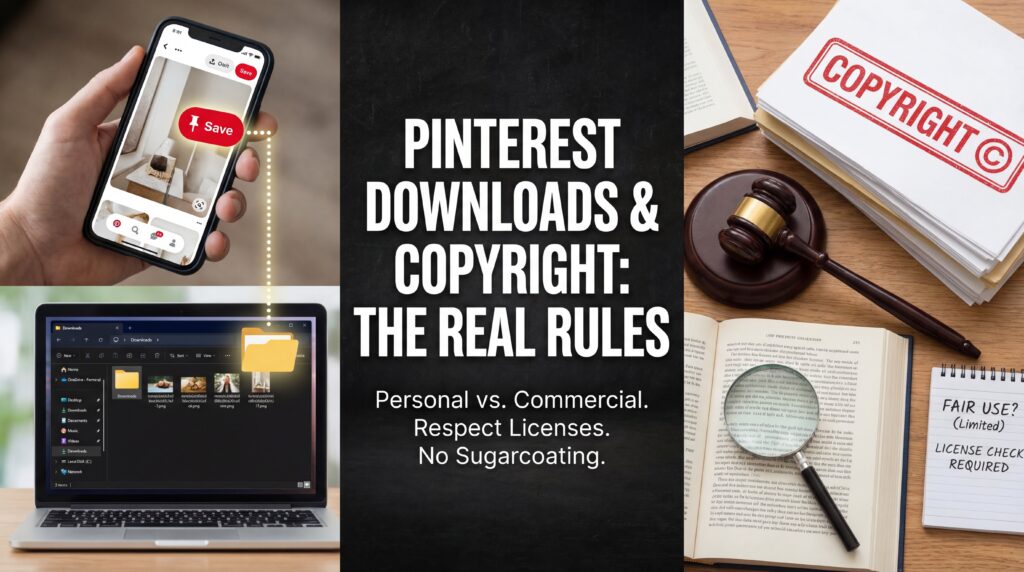
Let’s draw the line clearly, without legal gymnastics.
Usually Legal (Low Risk)
- Downloading a pin for personal, private use
- Saving content for offline reference
- Keeping files on your own device
- Using content as inspiration (not duplication)
This is where most users live.
Usually Illegal (High Risk)
- Reposting downloaded content as your own
- Uploading it to other platforms without permission
- Using it commercially (ads, products, courses)
- Removing watermarks or credits
- Selling or redistributing content
This is where lawsuits happen.
The law doesn’t care how you downloaded it.
It cares what you did with it next.
Fair Use: The Most Abused Phrase on the Internet
Ah yes. Fair use. The magical shield people wave around without understanding it.
Fair use is not:
- “I didn’t make money from it”
- “I gave credit”
- “Everyone else does it”
- “It was educational” (by default)
Fair use is a legal defense, not a permission slip.
Courts look at:
- Purpose (commercial vs educational)
- Nature of the work
- Amount used
- Effect on the original creator’s market
Translation? It’s complicated. And risky to assume.
If your entire business model depends on “fair use,” you’re playing roulette with lawyers.
Pinterest’s Terms of Service (The Part Nobody Reads)
Pinterest’s rules are blunt if you read them closely.
They allow:
- Viewing
- Saving within Pinterest
- Sharing through Pinterest tools
They do not explicitly grant permission to:
- Download content externally
- Rehost content
- Modify or redistribute pins
Pinterest protects itself first. Always.
If a creator files a complaint, Pinterest will side with the copyright holder—not you.
“But I See Reposts Everywhere” — Yes, and?
Speeding is common. So is tax evasion. Neither makes them legal.
The internet is full of copyright violations that simply haven’t been challenged yet.
Most creators don’t have time, money, or energy to chase every misuse. That doesn’t mean they can’t.
It just means you’ve been lucky so far.
The Creator’s Reality (This Part Gets Ignored)
Let’s flip perspectives.
Imagine you spend hours:
- Designing a graphic
- Filming a tutorial
- Editing a video
- Writing captions
- Optimizing for Pinterest SEO
Someone downloads it.
Removes your name.
Posts it elsewhere.
Gets traffic, followers, maybe money.
That’s not “sharing.” That’s erasure.
This is why creators are sensitive about downloads. Not because they’re greedy—but because the internet has a long history of rewarding thieves faster than makers.
Is Downloading Pinterest Videos Different From Images?
Legally? Not really.
Psychologically? Very.
Videos feel more “consumable.” Images feel more “ownable.” But copyright law treats both as protected creative works.
Downloading a Pinterest video for offline viewing is legally similar to downloading an image for reference.
What matters is reuse, not format.
Educational Use: Still Not a Free Pass
Teachers ask this all the time.
“Can I download Pinterest content for my class?”
Answer: Maybe.
Showing content in a classroom can fall under educational exceptions depending on country, but:
- Uploading it to public learning platforms?
- Including it in paid courses?
- Posting recordings online?
That’s where permission matters.
When in doubt: ask the creator. You’d be surprised how often they say yes.
International Laws: The Wild Card
Copyright laws vary by country, but here’s the pattern:
- Most countries protect creators by default
- Enforcement varies
- Platforms follow the strictest common denominator
So even if your local law is lenient, Pinterest’s policies and the creator’s country might not be.
The internet doesn’t care about borders when lawsuits start flying.
The Ethics Test (Better Than Legal Advice)
When legality feels murky, ethics usually aren’t.
Ask yourself:
- Would I be okay if this happened to my work?
- Am I benefiting more than the creator?
- Am I hiding the source?
- Would I defend this action publicly?
If the answer feels slimy, it probably is.
So… Should You Download Pinterest Content?
Here’s my honest, human answer—not a lawyer’s.
If you’re downloading:
- To learn
- To reference
- To use privately
- To improve your own skills
You’re probably fine.
If you’re downloading:
- To repost
- To profit
- To shortcut your own work
- To build an audience off someone else’s effort
You’re playing with fire.
Why This Question Won’t Go Away
Pinterest sits in a strange space:
- Not pure social media
- Not pure search engine
- Not pure marketplace
That hybrid nature confuses users and creators alike.
Until platforms build clearer systems—opt-in downloads, licensing tools, creator controls—people will keep asking this question.
And honestly? They should.
Because unclear rules benefit platforms, not users.